


Table of Contents
TLDR
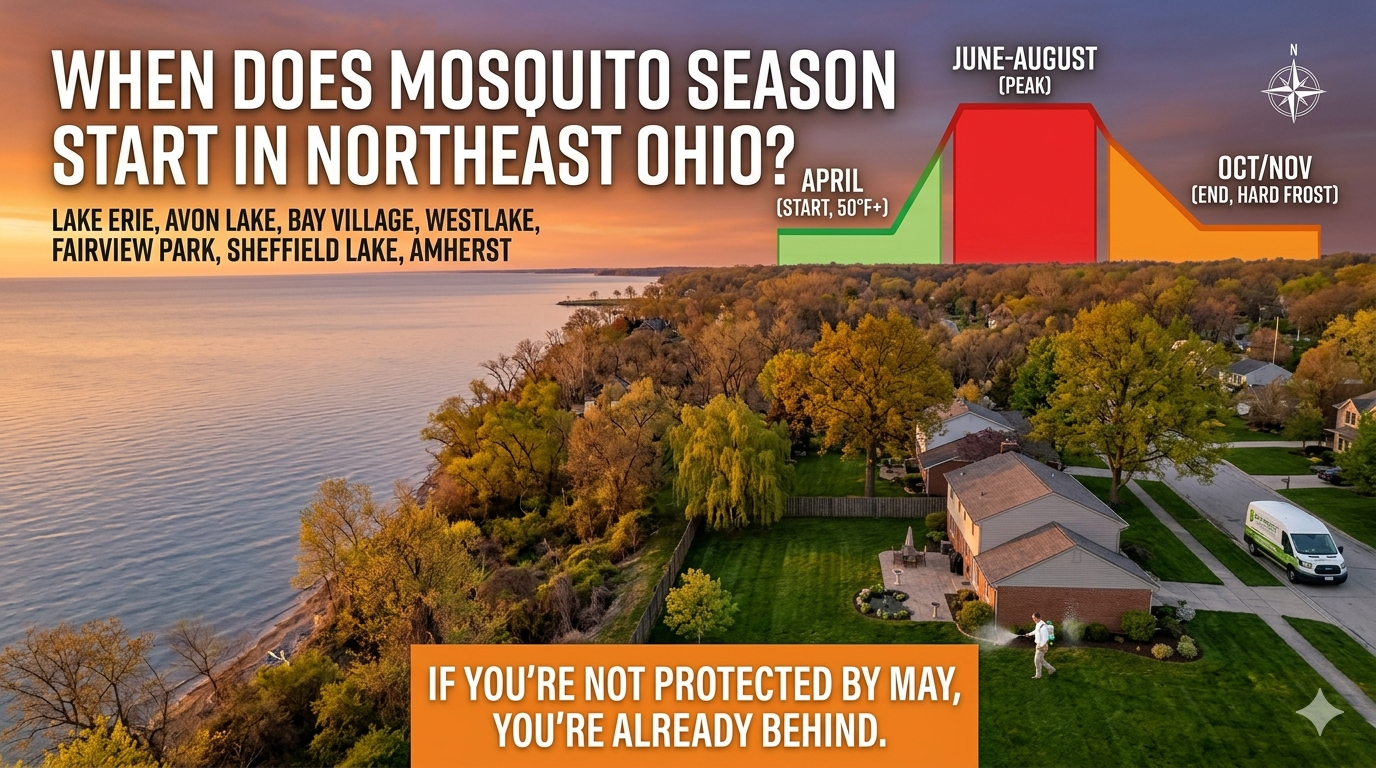
Northeast Ohio mosquito season officially begins in April when temperatures consistently reach 50°F, peaks from June through August, and winds down after the first hard frost — typically in October or November. Residents of Avon Lake, Bay Village, Westlake, Fairview Park, Sheffield Lake, and Amherst face a longer, wetter season than many other parts of the state due to Lake Erie’s humidity and abundant rainfall. If you’re not protected by May, you’re already behind.
The Direct Answer: When Does Northeast Ohio Mosquito Season Start?
Mosquito season in Northeast Ohio starts in April. According to the Ohio Department of Health, mosquito-borne illnesses are most often transmitted from May through October — but mosquitoes themselves begin emerging as soon as temperatures consistently stay above 50°F, which in Northeast Ohio typically happens in April.
That’s not just a technicality. In communities along and near Lake Erie — including Avon Lake, Sheffield Lake, Bay Village, and Westlake — warm, humid air off the water can accelerate early-season mosquito activity. If you wait until you’re being bitten to do something about it, you’ve already lost ground.
Why Northeast Ohio Is Especially Prone to Mosquitoes

Northeast Ohio mosquito season isn’t the same as mosquito season in Columbus or Cincinnati. The region’s unique geography creates conditions that mosquitoes absolutely love:
- Lake Erie humidity: The lake keeps summer temperatures moderate but dramatically raises humidity, giving mosquitoes the moist, warm air they need to thrive.
- High annual rainfall: The Cleveland-to-Lorain corridor receives roughly 38–40 inches of precipitation per year, and every rain event creates fresh standing water — a mosquito nursery.
- Dense vegetation: Communities like Fairview Park, Amherst, and Bay Village have mature trees and lush landscaping that create the shaded resting spots adult mosquitoes prefer during daylight hours.
- Proximity to wetlands and drainage areas: Sheffield Lake and areas along the Black River corridor in Lorain County are natural hotspots for mosquito breeding throughout the season.
⚠️ Local Health Alert: Lorain County — home to Avon Lake and Sheffield Lake — has historically reported some of the highest West Nile virus mosquito pool positivity rates in Northeast Ohio. Staying protected through the full season isn’t just about comfort; it’s about your health.
The Northeast Ohio Mosquito Season Timeline: Month by Month

Understanding how Northeast Ohio mosquito season progresses month by month helps you plan — and protect your family at the right time.
🌱 April — The Season Begins
Mosquitoes in Northeast Ohio don’t wait for summer. Once daytime temperatures reliably hit 50°F — which can happen as early as mid-April — overwintering mosquito eggs begin to hatch. Activity is low, but this is the ideal window to start preventive treatments before populations establish. A mild winter makes early emergence even more likely.
What you’ll notice: A few mosquitoes on warm evenings. Nothing alarming yet — but they’re breeding.
🌸 May — Building Momentum
May is when Northeast Ohio mosquito season really picks up. Spring rains fill gutters, birdbaths, clogged downspouts, and low spots in yards, giving mosquitoes unlimited breeding sites. Populations grow quickly, and by late May, outdoor activity in yards across Westlake, Avon Lake, and Bay Village starts to feel uncomfortable at dusk.
What to do: Have a professional treatment applied early in May if you haven’t already.
☀️ June — High Activity
June brings warmer nights and continued humidity from Lake Erie. Mosquito populations are now well-established and reproducing rapidly. Female mosquitoes can lay 100–300 eggs at a time in as little as a half-inch of standing water. Outdoor events, backyard dinners, and kids playing outside in Fairview Park or Amherst become noticeably more difficult without protection.
🔥 July & August — Peak Northeast Ohio Mosquito Season
These are the worst months. High temperatures, frequent summer storms, and peak humidity create ideal conditions. Mosquitoes are active from before dusk until after dawn, with the highest activity at dawn and dusk. This is also when West Nile virus risk reaches its annual high across Cuyahoga and Lorain Counties.
Ideastream Public Media reported in August 2025 that both Cuyahoga and Medina counties had confirmed West Nile cases, noting that late summer is typically when such cases begin to emerge — particularly following periods of heavy rain and high humidity.
What you’ll notice: Mosquitoes are everywhere. Untreated yards become nearly unusable after 6 PM.
🍂 September — Still Very Active
Many homeowners assume mosquito season in Northeast Ohio winds down in September, but they’re wrong. Mosquitoes remain very active through the entire month, especially on warm evenings. September rains refuel breeding cycles. West Nile virus transmission risk remains elevated.
🍁 October — Winding Down
Cooler temperatures begin slowing mosquito activity. Adult mosquitoes die off as nights dip below 50°F, and egg-laying slows significantly. However, mild October days — common in Northeast Ohio — can still bring mosquito encounters. Ending treatments too early can leave you unprotected on those warm fall days.
❄️ November Through March — Dormant Season
Once frost arrives and temperatures drop consistently below 50°F, adult mosquitoes die. Eggs overwinter in the soil, ready to hatch again next April. Northeast Ohio mosquito season is officially over — until next spring.
Common Mosquito Breeding Spots in Northeast Ohio Backyards

You might be unknowingly hosting a mosquito nursery right in your yard. These are the most common breeding sites in local homes across Avon Lake, Bay Village, Westlake, Sheffield Lake, Fairview Park, and Amherst:
- Clogged gutters — the #1 breeding site in Northeast Ohio; full of standing water and organic debris
- Birdbaths — must be emptied and refilled at least every 3–4 days
- Kids’ pools and toys — even a small amount of collected rainwater is enough
- Tarps and pool covers — water collects in folds and depressions
- Low spots in lawns — standing water from rain can persist for days
- Old tires or unused containers — classic breeding sites
- Decorative ponds without fish or circulation — stagnant water breeds mosquitoes fast
- Downspout extensions and drainage areas — common in older homes in Bay Village and Fairview Park
The Health Risks of Northeast Ohio Mosquito Season
Northeast Ohio mosquito season isn’t just an annoyance — it’s a genuine public health concern. The Ohio Department of Health identifies the following mosquito-borne diseases as risks for Ohio residents:
- West Nile Virus — the leading mosquito-borne disease in the continental U.S.; most common from July through October
- La Crosse Encephalitis — a rare but serious brain infection, more common in children
- Eastern Equine Encephalitis (EEE) — rare but severe; a risk in Ohio
- Zika Virus — primarily a travel-related risk, but can be locally transmitted
Important fact: In a recent year, Lorain County — encompassing Avon Lake and Sheffield Lake — recorded over 100 positive West Nile virus mosquito pools, the highest in all of Northeast Ohio.
According to Ohio public health officials, the best protections are:
- Using EPA-registered insect repellents containing DEET
- Wearing long sleeves and pants during dawn and dusk
- Eliminating standing water around your property
- Hiring a professional mosquito control service for season-long protection
DIY Mosquito Prevention Tips for Northeast Ohio Homeowners
While professional treatment is the most effective solution, there are steps every homeowner in Westlake, Bay Village, Amherst, Fairview Park, Avon Lake, and Sheffield Lake can take right now:
Weekly tasks:
- Empty and rinse birdbaths every 3–4 days
- Check gutters after every rain for blockages
- Flip or store any containers that collect water
- Check under decks and in crawl spaces for moisture
Monthly tasks:
- Inspect and clean downspout extensions
- Treat ornamental ponds with mosquito dunks (Bacillus thuringiensis israelensis, or Bti)
- Cut back dense vegetation and tall grass where mosquitoes rest
- Check tarps and pool covers for pooled water
Seasonal tasks:
- Clear leaf debris from gutters in spring before mosquito season begins
- Inspect fences, planters, and yard decorations for hidden water pockets
- Ensure window and door screens are tight-fitting and unbroken
⚠️ DIY Limitations: Even the most diligent homeowner cannot eliminate all breeding sites — especially on neighboring properties or in shared drainage areas. Professional barrier treatments are the most effective way to ensure season-long protection.
Why Avon Lake, Bay Village, Westlake, Sheffield Lake, Fairview Park & Amherst Are High-Risk Zones
Every community has its own mosquito profile. Here’s what makes the Avon Lake area particularly challenging during Northeast Ohio mosquito season:
Avon Lake & Sheffield Lake sit directly on Lake Erie’s southern shore in Lorain County. Humidity from the lake is constant from May through October, and Lorain County has some of the highest West Nile virus mosquito pool counts in the region. The area’s combination of waterfront properties, mature landscaping, and frequent summer rains makes it a mosquito hotspot.
Bay Village & Westlake are densely landscaped residential communities in Cuyahoga County with mature tree canopy, shaded yards, and older stormwater infrastructure — all of which create favorable resting and breeding conditions. Cuyahoga County also tracks West Nile virus actively and has confirmed cases in recent years.
Fairview Park is an inner-ring suburb with older housing stock and established vegetation. Properties here often have mature gardens and older guttering systems that are more prone to clogs — which means more standing water during Northeast Ohio’s rainy season.
Amherst lies further inland in Lorain County, close to the Black River corridor. Proximity to waterways, wetlands, and agricultural areas means mosquito pressure can be severe, especially mid-season.
How Professional Mosquito Control Works in Northeast Ohio

Professional mosquito control for Northeast Ohio works differently than a one-time spray. Because mosquitoes reproduce continuously throughout the season, effective control requires a programmatic approach:
- Initial inspection — A trained technician identifies breeding sites, resting areas, and high-activity zones on your property
- Barrier treatment — Shrubs, foliage, shaded areas, and lawn edges are treated with an EPA-approved product that kills adult mosquitoes on contact and provides residual protection
- Standing water treatment — Larval control products (such as Bti) are applied to any water that cannot be drained
- Repeat treatments — Because mosquito populations replenish every 2–3 weeks, recurring treatments (typically monthly from April through October) maintain protection across the entire Northeast Ohio mosquito season
- Follow-up monitoring — A good service provider monitors activity levels and adjusts treatments as needed
🚨Protect Your Yard This Mosquito Season
Don’t wait until you’re being eaten alive. Avon Lake-area homeowners who start mosquito protection in April or May enjoy a dramatically more comfortable summer than those who wait until peak season — when populations are already exploding.
Pest Asset is your local, trusted pest control company serving Avon Lake, Bay Village, Westlake, Fairview Park, Sheffield Lake, Amherst, and the surrounding Northeast Ohio communities. Our team understands the Lake Erie climate and the specific mosquito pressures our area faces — because we live and work here too.
📞 Call or text us today: (440) 899-2847 🌐 Visit us online: pestasset.com
We offer professional mosquito control treatments timed to Northeast Ohio’s actual season — not a generic national calendar. Whether you need season-long barrier protection or a one-time treatment for a backyard event, Pest Asset is ready to help.
Frequently Asked Questions About Northeast Ohio Mosquito Season
Q: When does mosquito season officially start in Northeast Ohio?
A: Northeast Ohio mosquito season typically begins in April, as soon as temperatures consistently reach 50°F. The Ohio Department of Health recognizes mosquito-borne disease season as running from May through October, but practical mosquito activity and breeding begins earlier — often in mid-to-late April.
Q: When is mosquito season the worst in Northeast Ohio?
A: July and August are peak months for mosquito activity in Northeast Ohio. High temperatures, Lake Erie humidity, and frequent summer storms create ideal breeding conditions. This is also when West Nile virus risk is highest in Cuyahoga and Lorain Counties.
Q: When does mosquito season end in Northeast Ohio?
A: Mosquito season in Northeast Ohio winds down after the first hard frost, usually in October or early November. However, warm October days can still bring significant mosquito activity, so treatments through early fall remain important.
Q: Do mosquitoes in Northeast Ohio carry West Nile virus?
A: Yes. West Nile virus has been confirmed in mosquito populations in both Cuyahoga and Lorain Counties. Lorain County has recorded over 100 positive mosquito pools in a single season. The risk is highest from July through October.
Q: Why are mosquitoes worse near Lake Erie?
A: Lake Erie’s humidity keeps the air moist throughout the summer, which extends mosquito activity and makes conditions more favorable for breeding and survival. Communities like Avon Lake, Sheffield Lake, and Bay Village experience this elevated humidity-driven mosquito pressure throughout Northeast Ohio mosquito season.
Q: Does a cold winter reduce mosquitoes the following summer?
A: Not significantly. Many mosquito species overwinter as eggs, which are extremely cold-hardy. A cold winter rarely reduces the following summer’s mosquito population in meaningful ways. Weather during the actual mosquito season — rainfall, humidity, and temperature — matters far more.
Q: How do I get rid of mosquitoes in my yard in Northeast Ohio?
A: The most effective approach combines eliminating standing water (gutters, birdbaths, containers), maintaining your lawn and landscaping to reduce resting sites, and scheduling professional barrier treatments from a licensed pest control company. DIY methods alone are rarely sufficient for full-season control.
Q: How early should I start mosquito treatment in Northeast Ohio?
A: April is the ideal time to begin. Starting early builds a protective barrier before mosquito populations peak, making season-long control more effective and more affordable than reactive treatment mid-season.
Q: Is Avon Lake a high-risk area for mosquitoes?
A: Yes. Avon Lake is located in Lorain County on Lake Erie’s southern shore, and Lorain County has historically had some of the highest West Nile virus mosquito pool counts in Northeast Ohio. The combination of lake humidity, seasonal rainfall, and dense residential landscaping makes the area one of the more active zones for Northeast Ohio mosquito season.
Q: What repellents work best against Northeast Ohio mosquitoes?
A: The Ohio Department of Health and CDC recommend EPA-registered repellents containing DEET, picaridin, IR3535, or oil of lemon eucalyptus. For yard-wide protection, professional barrier sprays are the most effective solution.
Key Takeaways & Conclusion
Northeast Ohio mosquito season is longer, wetter, and more intense than many residents realize — and communities along and near Lake Erie face some of the highest mosquito pressure in the state.
Here’s what you need to remember:
- ✅ Season starts in April — not June, not May. April, when temps hit 50°F.
- ✅ Peak season is July and August — plan outdoor activities and events with this in mind.
- ✅ Season ends after first frost — typically October or November.
- ✅ Lorain County (Avon Lake, Sheffield Lake) is a high-risk zone for West Nile virus mosquito activity.
- ✅ Lake Erie humidity extends and intensifies Northeast Ohio mosquito season compared to other parts of the state.
- ✅ Professional treatment starting in April provides far better results than reactive treatment in summer.
- ✅ Standing water elimination is the single most impactful DIY step any homeowner can take.
- ✅ West Nile virus is a real, confirmed local risk in Cuyahoga and Lorain Counties every year.
Sources & References
- Ohio Department of Health — Mosquito-Borne Diseases in Ohio
- Ohio Department of Health — Fight the Bite! Prevent Mosquito-Borne Diseases
- Ideastream Public Media — Northeast Ohio West Nile Cases, August 2025
- WKYC — Cuyahoga County West Nile Virus Monitoring
- Summit County Public Health — Mosquito & Tick Season 2025
Pest Asset proudly serves Avon Lake, Bay Village, Westlake, Fairview Park, Sheffield Lake, Amherst, and surrounding Northeast Ohio communities. Call (440) 899-2847 or visit pestasset.com to schedule your mosquito control treatment today.
Article last reviewed: May 2026 | © Pest Asset | pestasset.com | (440) 899-2847
