


Table of Contents
For informational purposes only. This article is not medical advice. Always consult a licensed medical professional for diagnosis and treatment of any bug bite or related illness.
Bug bite identification in Northeast Ohio has become more urgent than ever. Blacklegged (deer) ticks are now established in Lorain County and surrounding areas — and Lyme disease cases jumped from an average of 6.2 per year to 19 confirmed cases in 2024 alone. Mosquitoes, fleas, bed bugs, spiders, and chiggers are also common biters in communities like Avon Lake, Lorain, Westlake, Bay Village, Amherst, Rocky River, and Sheffield Lake. This guide teaches you how to identify what bit you, what the bite looks like, and when to take action.
The Short Answer: How Do I Know What Bit Me?
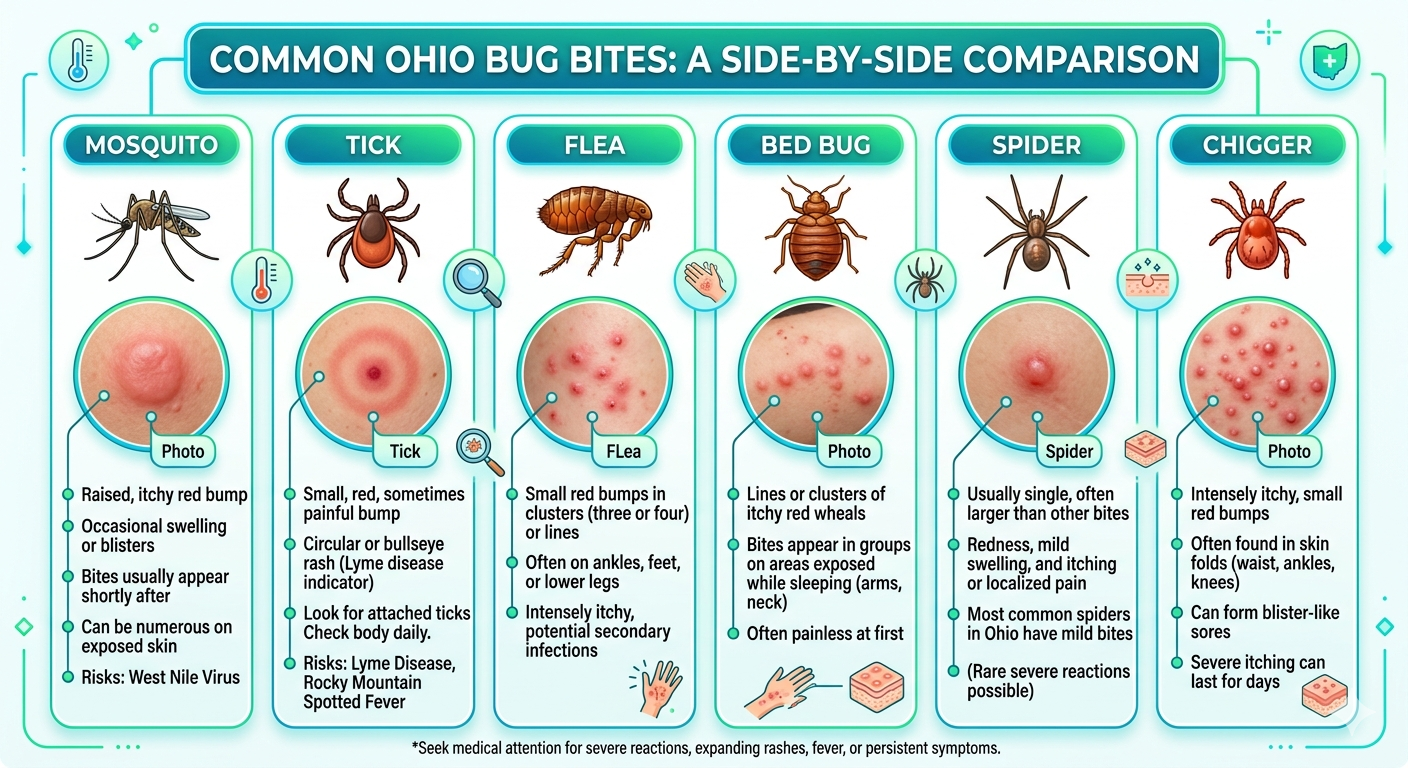
The fastest way to identify a bug bite in Northeast Ohio is to look at three things: the pattern of the bites, the appearance of the welt or mark, and where on your body it appeared. Mosquito bites are single, round, itchy bumps. Bed bug bites appear in lines or clusters on exposed skin. Tick bites are often painless and found in warm, hidden areas. Flea bites tend to cluster around ankles. Spider bites usually look like a red, inflamed bump — sometimes with two puncture marks. Chigger bites are intensely itchy and often appear around the waistline or sock line.
If you’re in Avon Lake, Lorain, Sheffield Lake, Amherst, Bay Village, Westlake, or Rocky River, the insects and arachnids you’re most likely to encounter are well-documented — and this guide covers every one of them.
Why Bug Bite Identification Matters More Than Ever in Northeast Ohio
Bug bite identification in Northeast Ohio isn’t just about stopping the itch. In recent years, the insects and arachnids in our region have become more varied — and more medically significant. The blacklegged tick (also called the deer tick) has migrated into Lorain County and surrounding communities, bringing Lyme disease risk that barely existed here a decade ago.
According to Lorain County Public Health, from 2019 to 2024, the county recorded 30 confirmed cases of Lyme disease — with a striking 19 of those occurring in 2024 alone. That’s a jump from a previous five-year average of just 6.2 cases per year. Statewide, the Ohio Department of Health tracked 1,791 Lyme disease cases in 2024, compared to just 557 in 2022 — a more than threefold increase in two years.
For residents of Avon Lake, Bay Village, Rocky River, Westlake, Lorain, Amherst, and Sheffield Lake — communities with abundant green space, Lake Erie shoreline parks, and wooded backyards — knowing how to identify bug bites and what’s behind them is a genuine public health matter.

The Most Common Bug Bites in Northeast Ohio (and How to Identify Them)
1. Mosquito Bites
What they look like: Small, round, puffy bumps with a tiny puncture in the center. They are pink or red and may develop a slightly darker center. The surrounding skin may be slightly swollen.
Where they appear: Any exposed skin — arms, neck, ankles, face, and legs are most common.
Sensation: Immediate itching that intensifies within minutes and typically fades within a day or two. Some people with sensitivities develop larger welts, called “skeeter syndrome.”
Health concerns in Northeast Ohio: Mosquitoes in our region can carry West Nile virus. The CDC tracked nearly 2,800 cases of mosquito-borne illness nationwide in 2023, with West Nile making up 95% of those. Symptoms of West Nile infection can include fever, headache, body aches, and, in rare severe cases, neurological problems. Residents near wetlands and retention ponds — common throughout Avon Lake, Sheffield Lake, and areas near the Black River in Lorain — are at elevated risk.
When to worry: Seek medical attention if you develop a fever, severe headache, stiff neck, or confusion after a mosquito bite.
2. Tick Bites
What they look like: Tick bites are often painless and difficult to detect. You may find the tick still attached. Once removed, the bite site may appear as a small red bump. A bull’s-eye rash (a red circle expanding outward from the bite) is the hallmark early sign of Lyme disease, though not everyone develops it.
Where they appear: Ticks migrate toward warm, hidden areas of the body — armpits, groin, scalp, behind the knees, and around the waistband.
Two ticks to know in Northeast Ohio:
- American Dog Tick — Larger, brown, with distinctive white markings. Does NOT carry Lyme disease. Common throughout the region.
- Blacklegged Tick (Deer Tick) — Tiny, often no bigger than a poppy seed in its nymph stage. Reddish-brown to black. Does carry Lyme disease. Now confirmed in Lorain County and spreading.
Health concerns: According to the Ohio Department of Health, Ohio experienced a 35-fold increase in Lyme disease cases over the past 13 years, driven by the expanding blacklegged tick population. Warmer winters and increasing white-tailed deer populations have accelerated their spread into communities throughout Lorain, Cuyahoga, and Erie counties — putting residents of Avon Lake, Amherst, Westlake, and Bay Village at real risk.
Early Lyme disease symptoms include the bull’s-eye rash, fatigue, fever, headache, muscle aches, and joint pain. Untreated, Lyme disease can affect the heart, nervous system, and joints. The key is early detection: a tick generally must be attached for at least 24 to 36 hours before it can transmit Lyme disease bacteria.
How to remove a tick properly:
- Use clean, fine-tipped tweezers
- Grasp the tick as close to the skin as possible
- Pull upward with steady, even pressure — do not twist or jerk
- Clean the bite area with rubbing alcohol or soap and water
- Do NOT crush the tick with your fingers
📌 Resource: Lorain County Public Health offers free tick identification. You can submit a photo to EH@LorainCountyHealth.com or call 440-322-6367. You may also bring a tick in a sealed bag to 9880 Murray Ridge Rd., Elyria.

3. Flea Bites
What they look like: Small, red, hard bumps with a “halo” of redness around them. They do not typically blister. Bites often appear in clusters of three or four.
Where they appear: Almost always below the knee — around the ankles and lower legs. Fleas jump from pets or carpet to bite the closest available skin.
Sensation: Intense itching that begins almost immediately. Unlike mosquito bites, the itch tends to last longer and scratching can break the skin, leading to infection.
Health concerns: Fleas are not just a pet problem. They can persist in carpet, furniture, and bedding for months. In Northeast Ohio, flea infestations tend to peak in late summer and early fall. If you have pets that go outside in Avon Lake, Westlake, or Rocky River parks and trails, regular flea prevention is essential.
At-home treatment: Wash all bedding and vacuum carpets thoroughly. Treat pets with veterinarian-approved flea prevention. OTC antihistamines and hydrocortisone cream can relieve itching.
4. Bed Bug Bites
What they look like: Red, flat or slightly raised welts that may appear in a line or zigzag pattern. Individual bites resemble small pimples or hives. Bites may have a dark red center.
Where they appear: Exposed skin while you sleep — commonly the arms, shoulders, neck, and face.
Sensation: Mild initial burning sensation that develops into intense itching. Some people have no reaction at all. Others develop a more significant allergic response.
What makes bed bug bites distinctive: The pattern — bites in rows or clusters on one side of the body, appearing overnight — is the biggest clue. Finding small blood stains or dark spots on your sheets or mattress seams confirms the identification.
Health concerns: Bed bugs are not known to transmit diseases, but infestations spread rapidly and are nearly impossible to eliminate without professional treatment. Hotels, apartment complexes, and second-hand furniture are the most common sources. Communities with higher residential density, including parts of Lorain and Amherst, have seen upticks in bed bug reports in recent years.

5. Spider Bites
What they look like: Most spider bites appear as a red, inflamed bump that may be painful. Venomous spider bites are more dramatic: the brown recluse bite starts painless but develops a red “bulls-eye” appearance, blisters, and can progress to tissue death (necrosis). Black widow bites may cause muscle cramps, sweating, and increased blood pressure.
Where they appear: Wherever bare skin contacts a hiding spider — often hands, arms, or feet when reaching into woodpiles, basements, or storage areas.
Spiders of note in Northeast Ohio:
- Wolf Spider — Common and large, but bite is mild; causes local pain and redness
- Yellow Sac Spider — Often found indoors; can cause a small, painful welt
- Brown Recluse — Rare in Northeast Ohio but not impossible; requires immediate medical attention if suspected
- Black Widow — Very rare but present in Ohio; neurotoxic venom requires emergency care
When to seek emergency care: Get medical attention immediately if you believe a brown recluse or black widow bit you. Signs of dangerous spider bites include severe pain, muscle cramps, fever, nausea, spreading tissue discoloration, or blistering at the bite site.
6. Chigger Bites
What they look like: Intensely itchy, red welts or pimple-like bumps. The skin may become raised and blister-like. Unlike ticks, chiggers don’t burrow — they bite and fall off, leaving a welt.
Where they appear: Where clothing fits tightly against the skin — waistbands, sock lines, behind the knees, and in skin folds.
Sensation: The bite itself is painless, but itching peaks 1-2 days after exposure and can be maddening. Chiggers are especially active in tall grass and brush — the kind found in woodland trail edges throughout Rocky River Reservation, Lorain’s lakefront parks, and green corridors in Amherst and Sheffield Lake.
Treatment: Shower immediately after outdoor exposure in grassy areas. Wash clothing in hot water. OTC hydrocortisone cream and antihistamines help manage itching.
7. Wasp, Bee, and Hornet Stings
What they look like: Immediate, sharp pain followed by a raised, red welt. Wasps and hornets can sting multiple times. Bees leave a stinger embedded in the skin.
What to do: Remove any embedded stinger by scraping it out (don’t pinch it). Apply ice, take ibuprofen for pain, and use an OTC antihistamine for itching.
When it’s an emergency: Anaphylaxis — a severe, life-threatening allergic reaction — can develop within minutes of a sting. Signs include difficulty breathing, facial or throat swelling, rapid heartbeat, dizziness, and sudden drop in blood pressure. Call 911 immediately. Use an epinephrine auto-injector (EpiPen) if one is available.
Bug Bite Identification by Appearance: Quick-Reference Chart
| Bug | Bite Appearance | Distinctive Feature | Sensation |
| Mosquito | Round, pink bump | Tiny center puncture | Immediate itch |
| Deer Tick | Small red bump or bull’s-eye rash | Rash expands over days | Often painless |
| Dog Tick | Small red bump | No rash; tick may be visible | Mild |
| Flea | Clusters of small red bumps | Below the knee | Intense itch |
| Bed Bug | Red welts in rows/lines | Appears overnight on arms/shoulders | Burning, then itch |
| Spider | Red, inflamed bump | May blister or darken | Pain varies |
| Chigger | Pimple-like welts | At waistband/sock line | Delayed, intense itch |
| Bee/Wasp | Red welt, possible stinger | Immediate sharp pain | Burning pain |
Where in Northeast Ohio Are You Most Likely to Encounter Biting Bugs?
Bug bite identification starts with knowing where bugs live. In our region, different environments attract different pests:
- Avon Lake & Sheffield Lake — Lake Erie shoreline areas, wetlands, and retention ponds create prime mosquito breeding habitat. Wooded residential yards attract ticks.
- Lorain — The Black River corridor, Lakeview Park, and areas of dense vegetation are known tick and mosquito habitats. Higher-density housing increases bed bug risk.
- Amherst — Rural and semi-rural edges with tall grass, farmland borders, and wooded lots are prime chigger and tick territory.
- Bay Village & Rocky River — Rocky River Reservation (part of the Cleveland Metroparks system) is beautiful but tick-heavy. Dog walkers and hikers should check themselves and their pets after every visit.
- Westlake — Suburban development adjacent to wooded areas creates “edge habitat” that both deer and ticks thrive in. Wooded backyards near Crocker Park and surrounding neighborhoods are worth monitoring.
- Sheffield Lake — Small parks and green corridors near Lake Erie bring mosquito and tick exposure, particularly in warmer months.

When to See a Doctor After a Bug Bite
Most bug bites in Northeast Ohio are uncomfortable but not dangerous. However, certain symptoms demand medical attention:
See a doctor if:
- A red, expanding rash develops around a tick bite (possible Lyme disease)
- Fever, chills, or flu-like symptoms appear within days or weeks of a bite
- The bite area becomes increasingly red, warm, or swollen
- You see pus, red streaks radiating from the bite, or a darkening center
- Swollen lymph nodes develop near the bite
Go to the emergency room or call 911 if:
- You experience difficulty breathing, throat tightening, or swelling of the face or lips after a sting
- You feel dizziness, confusion, or rapid heartbeat
- Nausea and vomiting follow a suspected spider bite
- A child under one year has been stung or bitten and shows any unusual symptoms
People with diabetes, weakened immune systems, poor circulation, or existing skin conditions should consult a doctor sooner rather than later after any significant bite.
How to Protect Your Home and Yard in Avon Lake and Surrounding Communities
Bug bite identification is important — but prevention is even better. Here are practical steps Northeast Ohio residents can take:
Outdoors:
- Apply EPA-registered insect repellent with DEET (20–30%) or picaridin when spending time outside
- Wear long sleeves and pants in wooded or grassy areas — tuck pants into socks in tick territory
- Perform tick checks on yourself, children, and pets after every outdoor outing, even in your own backyard
- Avoid outdoor activity during peak mosquito hours: dawn and dusk
- Keep grass mowed short and trim vegetation away from the home’s foundation
Around the home:
- Eliminate standing water — bird baths, clogged gutters, and tarps collect water where mosquitoes breed
- Inspect firewood, stored materials, and basements for spiders
- Use screens on windows and doors and repair any tears
- Regularly wash and inspect pet bedding for fleas
- When traveling or purchasing second-hand furniture, inspect carefully for signs of bed bugs
For persistent or recurring pest problems — including mosquito swarms, tick infestations, fleas, or bed bugs — professional pest control is the most effective solution. DIY sprays rarely address the root cause.
🐛 Dealing with Bug Bites in Northeast Ohio? Call Pest Asset.
If you’re finding unexplained bites in your home, noticing increased pest activity in your yard, or just want peace of mind — Pest Asset is your local expert. Serving Avon Lake, Lorain, Amherst, Westlake, Bay Village, Rocky River, Sheffield Lake, and surrounding communities throughout Northeast Ohio.
📞 Call us: (440) 899-2847 🌐 Visit: pestasset.com
Pest Asset offers professional identification, targeted treatments, and long-term prevention strategies for mosquitoes, ticks, bed bugs, spiders, fleas, and more. Don’t guess — get answers from a local expert who knows exactly what’s biting in your neighborhood.
Frequently Asked Questions About Bug Bite Identification in Northeast Ohio
Q: How do I know if I was bitten by a tick in Northeast Ohio? Tick bites are often painless and may go unnoticed until you find the tick still attached. Check warm, hidden areas of your body after outdoor activities — scalp, neck, armpits, behind the knees, and groin. A small red bump or, days later, an expanding circular rash (bull’s-eye pattern) are common signs of a tick bite.
Q: Are there Lyme disease ticks in Avon Lake, Westlake, or Bay Village? Yes. Blacklegged (deer) ticks capable of transmitting Lyme disease are now confirmed in Lorain County and are spreading throughout Cuyahoga and Erie counties. Lorain County Public Health reported 19 confirmed Lyme disease cases in 2024 alone, up from an average of 6.2 per year previously.
Q: What does a bed bug bite look like compared to a mosquito bite? Mosquito bites are single, round bumps that appear on any exposed skin and fade within a day or two. Bed bug bites appear in lines or clusters, usually on arms and shoulders, and typically develop while you sleep. The pattern — and the timing — are the biggest giveaways.
Q: How long after a tick bite do Lyme disease symptoms appear? A bull’s-eye rash typically appears within 1 to 4 weeks of a Lyme-infected tick bite, though it can take up to 3 months. Not everyone develops the rash. Other early symptoms include fatigue, fever, headache, stiff neck, and muscle or joint aches.
Q: Are chiggers common in Northeast Ohio? Yes, chiggers are present throughout Northeast Ohio, particularly in tall-grass areas, woodland edges, and along parks and reservations. They are most active from late spring through early fall. Their bites don’t appear until 1-2 days after exposure, which confuses many people about where they were bitten.
Q: What bug bites in a line? Bed bugs are the most notorious for biting in a straight line or cluster pattern — sometimes called “breakfast, lunch, and dinner.” Fleas can also bite in small groups. If bites appear in a line on exposed skin after sleeping, suspect bed bugs.
Q: Can spiders in Ohio cause serious harm? Most Ohio spiders are harmless and will only bite if threatened. Wolf spiders, the most commonly encountered large spider in Northeast Ohio, produce a bite that causes local pain and redness. Brown recluse and black widow spiders are rare but present — their bites require immediate medical attention.
Q: How do I get rid of mosquitoes in my yard in Avon Lake or Lorain? The most effective approach combines elimination of standing water (where mosquitoes breed), vegetation management, and professional mosquito control treatments. Pest Asset serves the entire Avon Lake, Lorain, and Westlake area with targeted mosquito reduction programs.
Q: When should I call pest control for bug bites? Call a pest control professional when bites are recurring with no clear cause, when you find evidence of an infestation (shed skins, fecal spots, live insects), or when home treatment hasn’t resolved the issue within a week or two. Some pests — particularly bed bugs and fleas — are extremely difficult to eliminate without professional-grade treatment.
Q: Is it safe to use DEET-based repellent on children? The American Academy of Pediatrics recommends that insect repellents with DEET are safe for children over 2 months of age when used as directed. Products with 10–30% DEET are appropriate for children. Avoid applying near the eyes, mouth, or hands. Always follow product label instructions.
Key Takeaways / Conclusion
Bug bite identification in Northeast Ohio is a practical, important skill — especially as tick populations grow and Lyme disease cases rise across Lorain, Cuyahoga, and surrounding counties. Here’s what every resident of Avon Lake, Lorain, Amherst, Bay Village, Westlake, Rocky River, and Sheffield Lake should know:
- Mosquito bites are the most common: round, itchy, single bumps on exposed skin
- Tick bites are the most medically significant in our region right now — blacklegged ticks carrying Lyme disease are confirmed and increasing in Lorain County
- Bed bug bites appear in lines or clusters overnight and require professional extermination
- Flea bites cluster below the knee and are tied to pet and wildlife exposure
- Spider bites are usually minor, but brown recluse or black widow bites are medical emergencies
- Chigger bites are delayed, intensely itchy, and associated with grassy or wooded areas
- When in doubt, see a doctor — especially if a rash, fever, or worsening symptoms develop after any bite
Prevention — repellent, protective clothing, tick checks, and controlling standing water — is your best defense. And for infestations that won’t quit, professional pest control is the smartest investment you can make for your family’s health and comfort.
Cited Resources
- Lorain County Public Health — Ticks https://www.loraincountyhealth.com/ticks Official tick surveillance data and identification resources for Lorain County residents.
- Ohio Department of Health — Lyme Disease Pathogen in Blacklegged Ticks Map https://odh.ohio.gov/wps/portal/gov/odh/know-our-programs/zoonotic-disease-program/media/lyme-disease-pathogen-in-blacklegged-ticks-map Current county-level data on tick-borne disease risk in Ohio.
- Ideastream Public Media — Ohio Lyme Disease Surge (2025) https://www.ideastream.org/show/sound-of-ideas/2025-07-29/ohio-sees-surging-cases-of-lyme-disease-driven-by-blacklegged-tick
- Healthline — Infected Bug Bite: When to See a Doctor https://www.healthline.com/health/infected-insect-bite-when-to-see-a-doctor
This article is for informational purposes only and does not constitute medical advice. If you believe you have been bitten by a dangerous insect or are experiencing symptoms of a tick-borne illness, contact a licensed healthcare provider immediately.
Pest Asset | (440) 899-2847 | pestasset.com | Serving Avon Lake, Lorain, Amherst, Westlake, Bay Village, Rocky River, Sheffield Lake, and surrounding Northeast Ohio communities.

