


Table of Contents
Living near Lake Erie means Northeast Ohio basements hold onto more moisture than basements almost anywhere else in the state — and that extra humidity is exactly what draws Northeast Ohio basement pests like house centipedes, silverfish, and earwigs indoors every July. The fix isn’t complicated: keep basement relative humidity under 50%, run a properly sized dehumidifier, clear debris from your foundation perimeter, and seal obvious entry points. Homeowners in Westlake, Rocky River, Avon Lake, Avon, Lakewood, North Olmsted, Bay Village, Fairview Park, Amherst, Sheffield Lake, Elyria, Vermilion, and Brooklyn deal with this every summer. If you’re already seeing activity, Pest Asset — owner-operated pest control serving the west side of Cleveland — can be reached at (440) 899-2847 or pestasset.com.
Why Do Basements Near Lake Erie Attract More Pests in July?
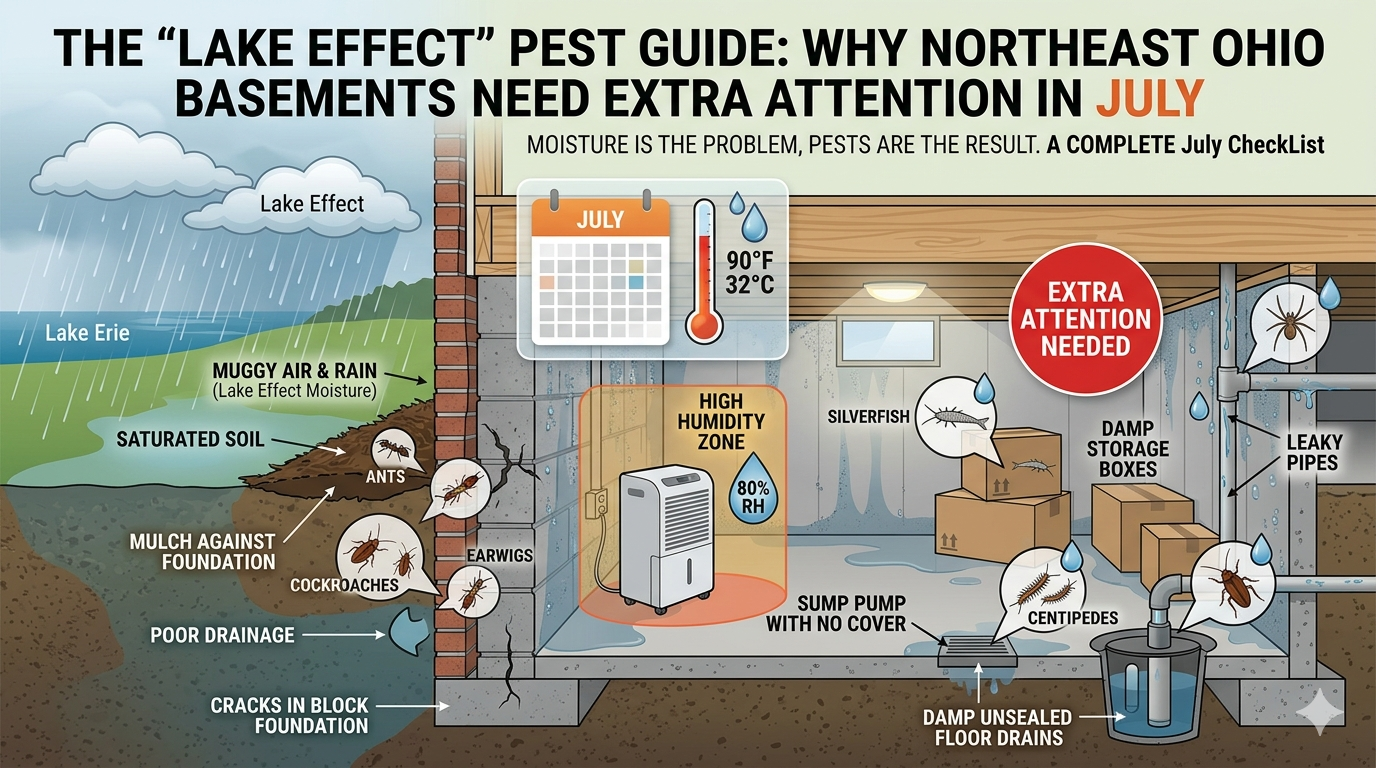
Basements near Lake Erie attract more pests in July because the lake pumps extra moisture into the regional air mass all summer long, and that humidity settles into below-grade spaces — basements, crawl spaces, and foundation perimeters — faster than it evaporates out. House centipedes, silverfish, and earwigs are all moisture-dependent insects. They don’t wander into a dry basement looking for trouble; they move toward damp, dark, undisturbed spaces because that’s where they feed, breed, and survive. If your basement runs humid in July, it’s advertising itself to exactly the pests that thrive on dampness. That’s the core of the Northeast Ohio basement pests problem, and it’s a pattern generic, national pest-control advice rarely accounts for.
Living Next to a Great Lake Changes Your Pest Risk
If you live in Westlake, Rocky River, Avon Lake, or anywhere else along Cleveland’s west side, you already know summer here feels different than it does 40 miles inland. Lake Erie is a massive body of water sitting right next to a densely populated shoreline, and it doesn’t just moderate temperatures — it also feeds a steady stream of moisture into the local air. Cleveland’s July climate normals show relative humidity commonly running in the 70s throughout the summer months, and Lake Erie’s surface water itself typically warms into the mid-70s°F by late July, adding even more evaporative moisture to the air moving inland off the shoreline.
That extra atmospheric moisture doesn’t stay outside. It seeps through foundation cracks, condenses on cool basement walls, and gets trapped in poorly ventilated crawl spaces. The result is what we call the “lake effect” pest problem: basements across Cuyahoga and Lorain counties routinely sit above the humidity threshold where pests start actively colonizing, even in homes that look perfectly clean and well-maintained.

Why Humidity Is the Real Driver of Northeast Ohio Basement Pests
Generic pest control advice tends to focus on food sources and clutter. Those matter, but in Northeast Ohio, moisture is the primary attractant for three specific basement invaders that show up disproportionately in this region every July:
- House centipedes — These fast-moving, many-legged insects are predators, not scavengers. They come inside because they’re hunting the other small insects (silverfish, spiders, springtails) that are already thriving in a damp basement. A house centipede sighting is often a signal that your basement is supporting a whole hidden food web.
- Silverfish — Silverfish need relative humidity above roughly 75% to reproduce successfully and can survive for long stretches without food as long as moisture is present. They feed on starches, paper, cardboard boxes, and book bindings — all common basement storage items — and a damp, undisturbed storage room is close to ideal habitat for them.
- Earwigs — Earwigs are outdoor insects by nature, living in mulch, leaf litter, and soil, but they migrate toward foundations during hot, dry spells and slip inside through the smallest gaps when the ground outside dries out faster than your basement does. Once inside, they gravitate toward the same damp corners as silverfish and centipedes.
None of these three pests are especially dangerous, but their presence is a reliable early-warning sign of a moisture problem that, left unaddressed, can also invite mold, wood-destroying pests, and structural issues over time.

The 50% Rule: Your Basement’s Most Important Number in July
Here’s the number every Northeast Ohio homeowner should know: the U.S. Environmental Protection Agency recommends keeping indoor relative humidity between 30% and 50%, noting that levels above that range create favorable conditions for mold and pests such as dust mites and cockroaches (EPA — A Brief Guide to Mold, Moisture and Your Home). Basements, being below grade and naturally cooler than the rest of the house, are usually the first place in a home to cross that 50% threshold — especially during a Northeast Ohio July when outdoor humidity off Lake Erie is already elevated.
How to Check and Control Basement Humidity
- Buy a hygrometer. These inexpensive humidity meters (often $10–$20) give you a real reading instead of a guess. Check your basement weekly during summer.
- Run a properly sized dehumidifier. Most standard basements need a 30–50 pint (or larger) unit run continuously during summer months to hold humidity below 50%.
- Empty and clean the dehumidifier reservoir regularly, or plumb it to a drain line so it runs unattended — a full reservoir stops working immediately.
- Ventilate strategically. Running a basement fan without a dehumidifier during a humid Northeast Ohio July can actually pull more moist outside air in — dehumidify first, ventilate second.
- Insulate cold surfaces, like uninsulated water pipes and rim joists, where condensation tends to collect and drip.
Clearing Your Foundation Perimeter: The Outside Half of the Problem
Basement humidity control only solves half the “lake effect” equation. The other half happens outside, at ground level, where earwigs, centipedes, and other moisture-seeking pests actually stage before finding their way in.
- Pull mulch, leaves, and organic debris back at least 6–12 inches from your foundation walls. Damp mulch piled against a house is one of the most common earwig and centipede staging areas we see across Rocky River, Bay Village, and Fairview Park properties.
- Redirect downspouts and grading away from the foundation so rainwater doesn’t pool against basement walls — a major moisture entry point in older Cuyahoga County housing stock.
- Trim vegetation and firewood stacks back from the house. Anything holding ground-level moisture against your siding gives pests a humid bridge straight to your foundation cracks.
- Seal visible foundation cracks, utility penetrations, and gaps around basement window wells, which are common entry points once pests are already staging nearby.
- Check window wells for standing water after summer storms, since they’re a frequently overlooked moisture trap right against the foundation.

Local Signals: Which Northeast Ohio Communities See This Most
Because of shared shoreline exposure and similar housing stock — older homes with block or fieldstone foundations and shallower basements — this pattern shows up consistently across the communities Pest Asset serves on Cleveland’s west side, including:
- Westlake, Rocky River, Bay Village, and Avon Lake (closest to the shoreline, highest direct lake-humidity exposure)
- Avon, North Olmsted, and Fairview Park
- Lakewood and Brooklyn (older housing stock with more basement moisture vulnerabilities)
- Amherst, Sheffield Lake, Elyria, and Vermilion (Lorain County homes with similar shoreline-adjacent humidity patterns)
If you’re in any of these areas and noticing more basement bugs than usual this July, you’re not imagining it — it’s a documented, regional pattern, not just a problem with your specific house.
Frequently Asked Questions
Q: Why do I suddenly see more bugs in my basement every July? A: July combines peak outdoor humidity from Lake Erie with warm temperatures, which accelerates insect activity and reproduction. Basements, being naturally cooler and damper than the rest of the home, become a magnet for moisture-seeking pests during exactly this window.
Q: Are house centipedes dangerous? A: House centipedes can deliver a mild pinch if handled, but they aren’t considered a serious health threat. Their presence is more valuable as an indicator that your basement is supporting a broader insect population than as a threat on its own.
Q: What humidity level should my basement be at to prevent pests? A: Aim to keep relative humidity at or below 50%, in line with EPA mold-prevention guidance. Many pest species that thrive on moisture, including silverfish, struggle to reproduce once humidity drops meaningfully below that range.
Q: Will a dehumidifier alone solve my basement pest problem? A: A dehumidifier addresses the indoor half of the problem. You’ll also need to address exterior moisture sources — mulch against the foundation, poor grading, and gaps around the foundation — for lasting control.
Q: Do earwigs and silverfish bite people or damage the home? A: Earwigs rarely bite and aren’t structurally damaging. Silverfish don’t bite but can damage stored paper goods, wallpaper, book bindings, and cardboard boxes over time if left unaddressed in a humid storage area.
Q: When is the best time to treat for basement pests in Northeast Ohio? A: Early-to-mid summer, before the peak humidity of late July and August, gives you the best window to correct moisture issues and treat proactively rather than reactively.
Key Takeaways
- Northeast Ohio basement pests — house centipedes, silverfish, and earwigs — are drawn indoors primarily by humidity, not clutter or food alone.
- Lake Erie’s proximity keeps regional summer humidity elevated, and basements are usually the first part of a home to cross the pest-friendly 50% relative humidity threshold.
- The EPA’s 30–50% indoor humidity guideline is a practical, science-backed target for basement pest prevention, not just mold prevention.
- Controlling humidity requires action both inside (dehumidifiers, ventilation, insulation) and outside (mulch clearance, grading, sealing gaps) your foundation.
- This is a documented regional pattern across Westlake, Rocky River, Avon Lake, Avon, Lakewood, North Olmsted, Bay Village, Fairview Park, Amherst, Sheffield Lake, Elyria, Vermilion, and Brooklyn — not an isolated issue.
Get Ahead of Your Basement’s Humidity Problem This July
If your basement is already showing signs of centipedes, silverfish, or earwigs, waiting until August won’t make the humidity go away on its own. Pest Asset is a locally owned, owner-operated pest control company serving Cleveland’s west side and surrounding Northeast Ohio communities — when you call, you talk directly to the person doing your inspection and treatment, not a call center or a rotating technician.
Call (440) 899-2847 or visit pestasset.com to schedule a basement pest inspection before peak summer humidity makes the problem worse.
Sources: U.S. EPA — A Brief Guide to Mold, Moisture and Your Home; National Weather Service Cleveland, OH (NOAA)
